’This is not all, the closets are full’:
Discussing queer violence and trauma in Croatia using the example of the first gay pride parade with a focus on ways queer iconography is mobilised by artist Igor Grubić in ’East Side Story’ with an emphasis on public space.

CONTENTS
I. INTRO
2. A personal momentum; Growing up in a country that was recovering from a recent war and a country that was still looking for its cultural identity
3. FINE MRTVE DJEVOJKE (Fine dead girls) – Vanja Cuculić
4. EAST SIDE STORY – Igor Grubić
4.1. WHAT IN THE EX-YU DIASPORA IS GOING ON HERE!?
4.2. A HEALING CATARSYS
4.3 MOJA ČETIRI ZIDA SU HRVATSKA (My four walls are Croatia)
OUTRO
BIBLIOGRAPHY
I. INTRO
“Liberation, legitimacy, dignity, acceptance, and assimilation, as well as the right to be different: the goals of gay pride require nothing less than the complete destigmatisation of homosexuality, which means the elimination of both the personal and social shame attached to same-sex eroticism.” (HALPERIN, 2009)
In this written piece I will focus on trauma as an event, specifically the 2002 Gay pride event in Zagreb, Croatia, as well as detailing a personal response to the role this trauma has had in subsequent generations. Furthermore, the goal of this essay is to shine a light on the tactics and ways Croatian artist Igor Grubić has utilised trauma processing as a medium and further discuss the ways he brings these trauma archives back into reality and the public sphere.
In the next part, I will write a personal testimony that will ultimately be tied to a poster later mentioned and talked about in terms of publicity and the public showcase of non-explicit and non-erotic queer themes, and the relationship between public reactions in the contemporary west as opposed to the Croatian socio-political climate.
This essay will be structured to explore my personal connection to the subject as well as my reasonings for writing about these topics, followed by an exploration of the 2002 pride march that will ultimately lead to a close analysis of Grubić’s work.
This piece of writing will use literature by Ann Cvetkovich, Judith Butler, Paul B. Preciado and others as a theoretical basis by which this piece will set to recontextualise these events and happening as well as bring in queer theory and critiquing traditional epistemological approaches to media depictions of queerness to further investigate the damage these events have caused.
Furthermore, this work will analyse and present the dynamics of queer people as well as ekphrasis and critically analyse the work and the ways this work talks to themes of trauma, as well as, if and how it has helped or hindered the progress of these themes.
2. A PERSONAL MOMENTUM
Growing up in a country that was recovering from a recent war and a country that was still looking for its cultural identity
From a young age, it was very evident that there was a certain way to live and operate within the confines of traditionality that had been influenced by cultural momentums; the various empires and structures that have been in power since ancient times.
For as long as I remember, queerness has been a moment and spectacle that was rarely talked about in the ex-Yugoslavian diaspora; even less so in a positive light. My whole childhood was spent listening to queerness being ridiculed and demonized by the media, by friends and family, by religious institutions, and by pedagogicall institutions. Not until the point I turned about fifteen years old had there been a person in my life that had considered queerness as a natural and normal quality of someone’s identity.
Growing up, similarly to most queer people globally, I was used to but deeply hurt when hearing phrases such as “Why are you crying, don’t be such a little girl, when you have a partner of the opposite sex and children (not to say that gender was something people had a sensibility towards, if anything there was a deep misogynistic undertone to anything that had to do with socioeconomic topics), when you become a real man, when you become a provider…”… luckily enough I lived in a household where the only male person was my father and I was raised by 3 beautiful women alongside my little sister. I had always felt more comfortable in confiding and spending time with the women in my life, whereas for men it was a whole different story. All of this of course can be linked to “Compulsory heterosexuality” where Rich identifies heterosexuality as “a political institution which systematically works to the disadvantage of all women” (RICH, 1986)
“It is true that masses of men have not even begun to look at the ways that patriarchy keeps them from knowing themselves, from being in touch with their feeling, from loving… They must be able to choose life over death. They must be willing to change” (HOOKS, 2005)
Naturally, not every person used to be negative towards homosexuality, but I often found that those who were ’most’ accepting said things like “it is fine as long as it’s not my child, as long as they do ’IT’ within their four walls, it’s a Hollywood fantasy… etc.”. It had been presented as monstrous and by many believed to threaten the very structures of a traditional Croatian (Ex-Yu) lifestyle but more importantly, it seemed to be a direct attack on the idea of a “holy” family unit.
I often failed to understand how this traditionality could be put forward as an argument, considering that a lot of that same “tradition” came from a moment when Croatia was a part of the Nazi state. Absurd.
“Based on a blend of Roman Catholicism and fascism, the group had no qualms about using genocide and terror to reach its ultimate goal of creating an independent and purely Croatian state free from Yugoslavian influence…By the end of the war, an estimated 30,000 Jews, 29,000 Romani, and between 300,000 and 600,000 Serbs had been slaughtered by the Ustaše.” (STOCKTON, 2019)
The Ustasha were a part of the movement in which the catholic church gave them full support. They have done monstrosities and have sided with the Nazi German state as well as the fascist-Italy state.
Two very important moments have been engraved into my memory and hold so much power over me still to this day. Both happened the first time I visited London, they were moments so simple and trivial, yet they fundamentally made me accept truths and question the structures of power that have dictated my life.
My entire childhood had been spent socialising privately through western media by consuming western queer media; and contrary to that I had publicly been socialised through a Croatian lens through everyday life. Arriving in the UK allowed for a public engagement with the media I had been consuming away from public facing sociality in Croatia . Therefore in the next paragraph, I will describe the shock experienced with seeing this kind of imagery publicly shown, but even more than that, the shock as people around me paid little to no notice to the poster presented. I will then, in a later section, present a poster designed for a play that created an uproar of confusion and anger in Croatian society. What I found interesting was how the public space in London was inherently more prone to the imagery that had a freer sense of presenting and how it was not dictated by an institution such as church or state.
I had been taken to central London and as I was walking through the busiest streets, I looked up to see a billboard, which at the time seemed to be as big as an Olympic-sized pool and as lit as the world cup stadium. I vividly remember what it looked like and the feeling that arose in me at that moment was a mixture of happiness, love, confusion, and pride. If I remember correctly, it was an ad for a company, most likely situated in the heart of Soho depicting two male-presenting people showing affection through a kiss. My body stood paralyzed at this site. I had only experienced this kind of imagery publicly shown to provoke and comment on current political events in countries like the one I was from— a country that has no queer community outside of private gatherings and secret meetings. This poster was there for a different reason, albeit a commercial one, I was simply not used to this sort of sight. It was a truly seminal moment, something that made me want to think more critically and probe more deeply into the confines of life I had gotten used to before. Something that made me angry about the ways of my existence and the ways that existing wasn’t full-hearted because of perpetual fear. This was the first point in the chain reaction that started thought processes that have been silently happening in the background.
The second of these moments happened the first time I visited Tate modern. Enter: a young boy that had yet to enter his twenties who just finished a vocational school of art and design and was so excited to see the artworks he had studied about for the past 5 years of his life. It would not be the artwork he had known about that would mark his visit and solidify his opinions. It was a new art piece that spoke to him in a way that awoke this anger and disappointment that has been buried deep within, waiting to be unleashed.
Being lost in such a big foreign city for a while, I suppose what made me witness this art piece was the name of a Croat that was tied to it. The work was exhibited in a separate darkened room, a room for projections and films, easily missed. I was attracted by the familiarity of his name, and the title “East side story” really drew me closer, as if I had no choice but to enter it. I then discovered that it was even more personal than just sharing a nationality. The videos showed a life that I had known very intimately, maybe not in the terms of physical violence portrayed but more so in terms of psychological violence and exclusion. I was both disgusted and amazed to be watching this; “of course, this is the first Croatian work I see here, #notsurprised” was probably what was going through my head while experiencing it. It drew tears to my eyes but also left me feeling numb for the rest of the afternoon, what an amazing feeling it was to have an artwork do that to me.
Reflecting on it now I can observe that this work was presented in a well-known institution and museum, a space that didn’t face any kind 9 of threat to be vandalised based on the imagery that it was showing and the message it was intended to send. The audience would be other people who in viewing this would, in a worst-case scenario, leave the room.
This work in particular is what I will talk about in the later parts of this written piece, and I will utilise it to argue and question the transmutation of violent acts and the turn of physical violence on LGBTQ+ individuals and groups at the start of the first decade of the 21. Century, as well as looking into the modes of trauma processing and healing through performative re-enactments using happenings as artistic responses.
“The memory of trauma is embedded not just in narrative but in material artefacts, which can range from photographs to objects whose relation to trauma might seem arbitrary but for the fact that they are invested with emotional, and even sentimental value.” (CVETKOVICH, 2003)
3. FINE MRTVE DJEVOJKE
(Fine dead girls) – Vanja Cuculić

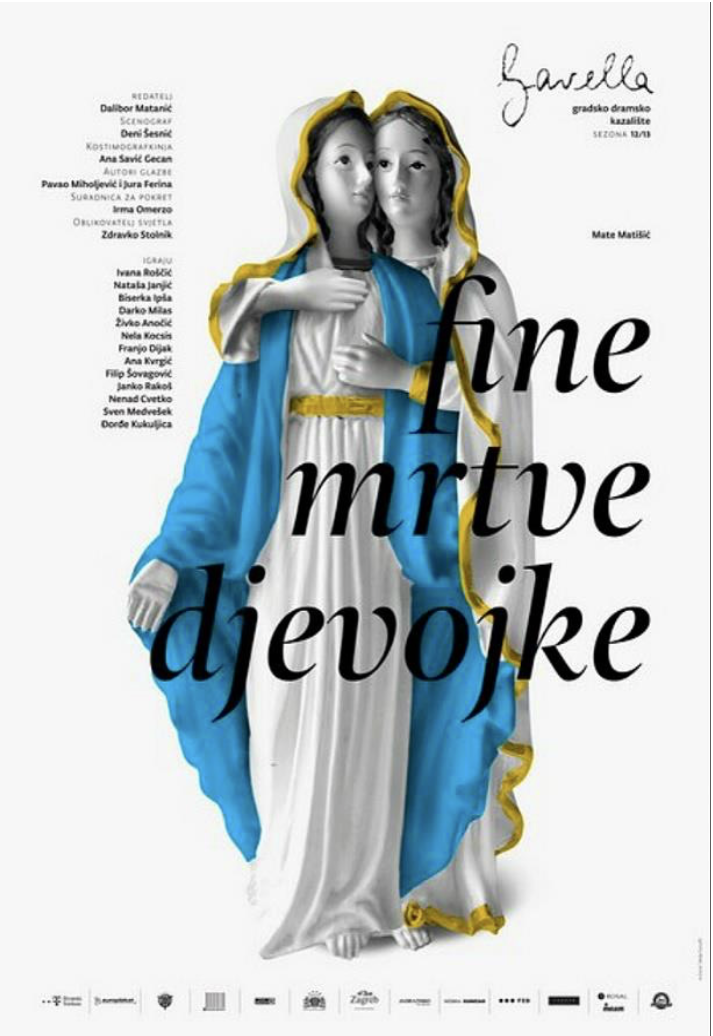
Because of the formal connection this imagery has to the imagery of the poster I had described seeing in Soho, London, I have presented it here to show the reactions that I was accustomed to experiencing in a public setting in Croatia. It offers a comparison to similar visual media, and more importantly the response to similar visual media in different geo-political settings.
The work of Vanja Cuculić depicting two porcelain figurines of the Virgin Mary embracing each other in a hug was a poster made for a play and later film made in 2013, titled “Fine mrtve djevojke” (which translates into “Fine dead girls”).
This is a tragic lesbian love story conditioned by a not-so-inclusive and a not so “open” Croatian society.
When the poster was published it created a huge controversy. People from the whole country felt very offended and their political and religious opinions seemed threatened; institutions freely talked about this being a hate crime towards the church and the initiation of pejorative discourses. Yet news outlets and tabloids failed to mention the blatant homophobia that the same institutions and religious and political leaders were showing.
“Recently two small porcelain figurines depicted on a theatre poster promoting a lesbian play “Fine, Death Girls” deeply upset Croatian society, both Catholics and Muslims, believers and non-believers, but also politicians. The image of two holly Virgin Maries, lovingly embracing one another across the shoulder, in shining blue-and-white porcelain – that was too much of a stress for religious and political leaders.”. (GREIF, 2013)
The poster was short-lived as the Major of Zagreb asked for all the posters to be removed, and they shortly were.
“After the poster for the theater show was ostracized and removed from the public eye, many artists protested. Theater actors, and intellectuals and the whole ensemble of Gavela theatre where the two virgins Maries incident occurred, condemned the act of religious and political censorship of art. Only one politician supported them, the mayor of the city of Rijeka, who invited the show to his city.” (GREIF, 2013)
The work interesting doesn’t portray queer sexuality as the embrace is not necessarily erotically charged, despite the tame subject matter, the reaction emphasises a wide societal distrust of nonheteronormative displays of affection. In contrast to the ubiquity and relative unprovocative nature of similar works in the UK. Further, the public nature of the medium highlights this essay’s themes of public intolerance to displays of queer life.
4. EAST SIDE STORY – Igor Grubić

Igor Grubić said in an interview that his initial idea for “east side story” was to execute interviews with the protagonists of the film. After examining the footage, he talks about a recurring sense of sickness in his gut and disbelief that people could be so brutally cruel to one another just because of their differences. He continued by saying that because of being continuously shocked by this fact, he decided to go and explore this bodily feeling that arose in him. And so, he decided to work with dancers in a public space, who would in a symbolic way evaluate the locations where these gruesome events happened. (Igor Grubić in an interview done for a Croatian newspaper and media company in 2010) In the following part, I will explain and analyse this artwork as well as mentioning some ideas mentioned in the paragraphs above and applying them to this work.
4.1 WHAT IN THE EX-YU DIASPORA IS
GOING ON HERE!?
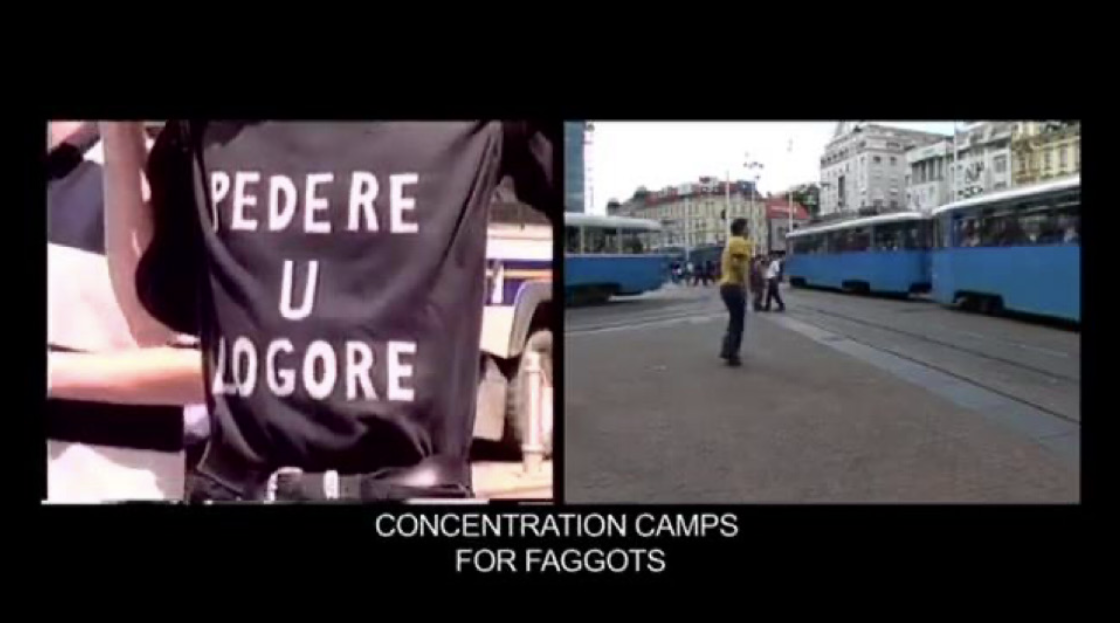
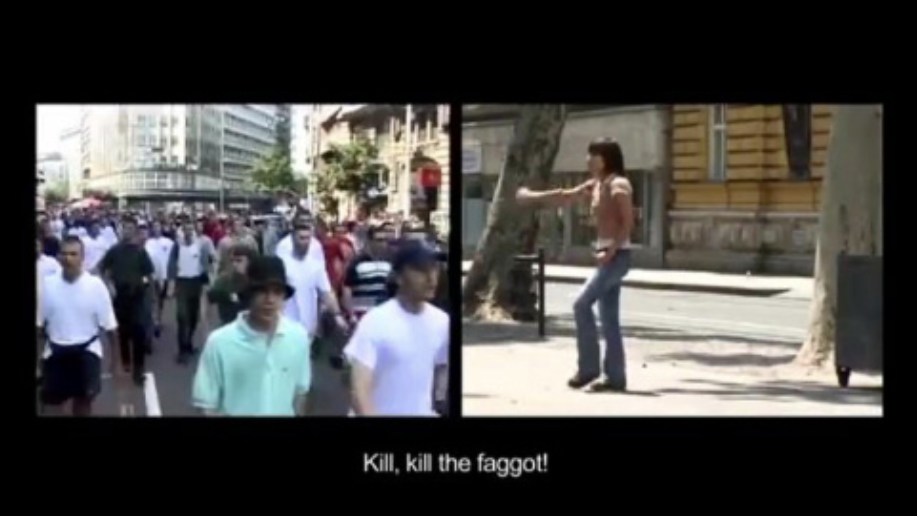
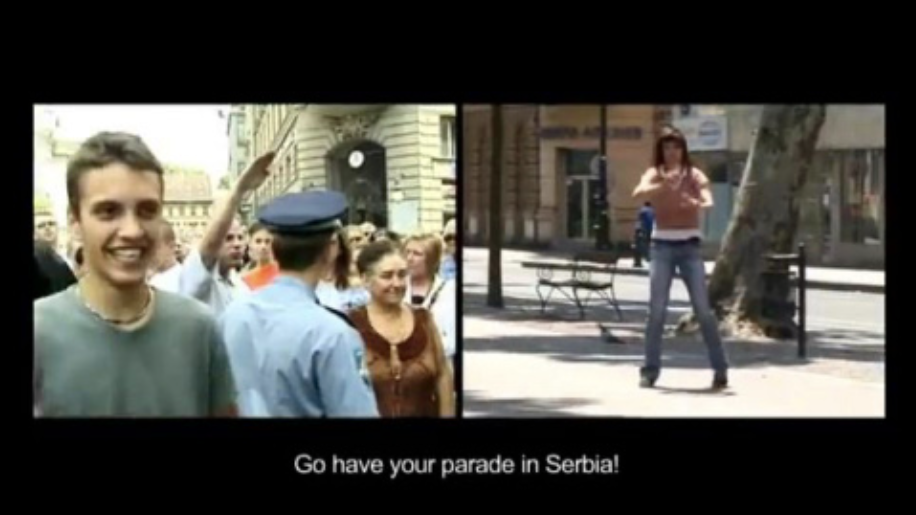
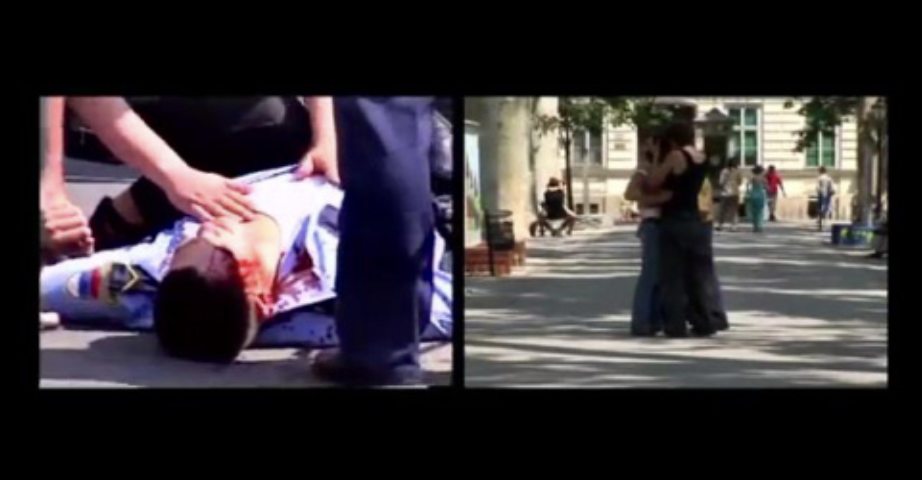
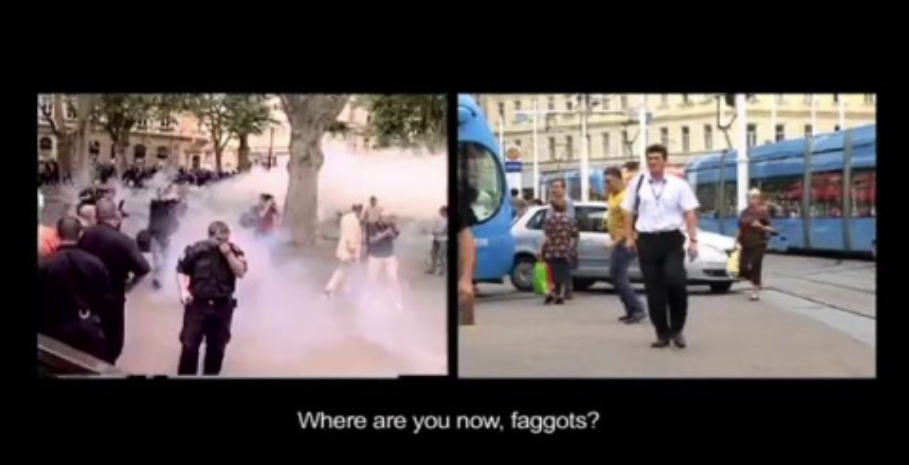
The two-channel projection and performance piece by artist Igor Grubić shows two video works showing the first gay pride parades on the territories of the capital of Croatia; Zagreb, and the capital of Serbia; Belgrade, as well as a performance piece by Croatian dancers who are translating the events and sounds into a bodily reaction.
The first of the videos initially begins with a sense of suspense that dominates. We follow shots of armed police who prepare for an eventual confrontation, we move on to shots of protestors of Gay Pride Zagreb standing nervous but undoubtedly proud of their demonstration. All these shots are accompanied by loud music playing in the background. As the music starts to fade, the audience starts to boo and make rude gestures. We then see banners that have words such as “our rights are human rights” as well as “No for gay rights”.
What follows is a disturbing showcase of Neo-Nazis who are chanting rhythmically and yelling threats at paradegoers while asserting violent body language. As the suspense peaks, and very abruptly… a little push becomes a violent conflict.
We next witness captured shots of horrifying events such as a man getting caught, cornered, and then continuously kicked in the head, we see a woman chasing after a police car and urgently pleading for assistance, and blood-stained officers fleeing the angry mobs who are violently chasing them in the streets, we then see an old woman gesturing with the Croatian nationalist salute to a crowd and a young man reciprocating the Hitler salute.
While the marchers are fighting for their lives and attempting to handle the issues on their own, we catch glimpses of a group of photojournalists and camera operators who are running around them in a fog of tear gas. Meanwhile, the older members of the hostile mob are yelling slurs and death threats at the marchers.
The second video shows four dancers reacting to the events of the first video. Using their bodies, they mimic and move in a way similar to the people in the original parades, performing these choreographies along the march routes that protestors followed in 2002 in Zagreb.
The dancers first enter the space on their own, gesticulating and transforming movements from the videos into dance sequences. Their bodies communicate emotions that span from sadness to confusion to anger. In the later parts of the video, the dancers perform together re-enacting the clash of people as shown in the documentary video, until finally joining their bodies together and moving as a mass.
In some moments the dancers seem to be afraid and shield themselves from an attack while in others they are the attackers, in the same way when the dancers hear violent slurs or loud noises their bodies contract while in other moments, they start following the rhythmic chants and joining in.
4.2 A HEALING CATARSYS
There is something very interesting happening when looking at the work of Grubić, the way he utilises the dancers’ bodies, the locations and the format of the artwork really speaks to ways of healing and understanding an event that influenced people’s marginalised lives in the period this was happening in. He uses the happening as a tool to primarily heal the pains inflicted by the traumatic moments that happened in the early 2000s. He decides to use bodies that re-enact the documentation of the first gay pride as well as placing them in locations these events happened in; to be more exact in Zagreb. In this way, he goes into a direct conversation with the bodies and locations that still hold this trauma.
“Trauma puts pressure on conventional forms of documentation, representation, and communication, giving rise to new genres of expression, such as testimony and new forms of monuments, rituals, and performances that can call into being collective witnesses and publics.” (CVETKOVICH, 2003)
By working with memory and the aftermaths of memory. His project becomes multi-layered commenting not only on the events that happened but also in a way communicating the dissatisfaction with the action taken by government bodies to enact these changes and to bring justice into the light. Therefore, he decides to work with violent traumas in public spaces. If this kind of performative enactment of trauma didn’t happen, we could only expect a violent acting of trauma to appear. In a way, he weaponizes his art as a way of fighting injustice and bigotry.
“…gay, and lesbian archives address the traumatic loss of history that has accompanied sexual life and the formation of sexual publics, and they assert the role of memory and affect in compensating for institutional neglect.” (CVETKOVICH, 2003)
The work itself took about 2-3 years to create and the dance took about 2-3 months to choreograph. The first idea for this work was for it to be a kind of documentary that has the football hooligans and neo-Nazis partake in workshops designed around themes of queerness and the events that happened in Zagreb and Belgrade, this was the initial plan up until Grubić looked at the footages of the event and had such a bodily reaction to it, as does anyone who sees these clips either on their digital devices or in an exhibition setting such as the Tate modern. He finally decided to work with dancers and choreographed the dance in public spaces as a way of embodying the traumas the public space had soaked in.
By choosing to not work with neo-Nazis, he is indirectly communicating that they are a lost cause. The belligerent party is absolved of consequences because their actions and beliefs cannon be reconciled.
Grubić chooses to edit the clips together but not censure the horrifying violence portrayed in the videos, alongside this he chooses to add another video next to it with dances performing, and what seems to be, copying the movements of the original video. The dancers here take on an almost decorative form, not really doing anything outrageous but simply filling the rest of the room up. We have to ask ourselves if the dancers were not in this work would the piece hold the same weight, or rather, what would change in viewing this work if the other video wasn’t present? Naturally, the work would be sinister and gruesome to watch but I don’t believe that the message would be lost in translation if the dancers weren’t there. If anything, returning to the decorative term that was introduced, the dancers in a way, allow us to take a break from these violent views and help us watch the work to its completion. They serve as a sort of companion and reminder that the fight isn’t over yet and that there are still active ’actors in this play’.
Calling it a play of course has no intention of making it seem less relevant or big but simply saying that this is something that is still actively happening and that even the passive and active parts in this event are still eagerly waiting for the fight to be done.
“De Certeau’s (1990) well-known discussion of walking in the city ’as a space of enunciation’ captures this dynamic well since in this view it is the act of walking that gives meaning to the urban system. Pushing this insight further however, we might want to suggest that rather than walking in the city giving meaning to the prior system of urban meaning … it is rather movement through the city that performatively produces meaning.” (PENNYCOOK, 2010)
On further reflection on the dance and the choreography, raises the question of whether the performance is sufficient in situ reclaiming of space by queer performers. Particularly in light of the limited use of queer iconographies such as for example drag queens and kings, pride flags, or another queer iconography. There is nothing apparent that signalises queerness about the dance. It isn’t until you have the context of the video of the marches that you can understand that the other video is “queer”. It is a muted response; it is a response that many other queer people wouldn’t have when faced with the shocking nature of the documentary footage. It seems to be safe and not at all a reclaiming of space.
Another decorative moment in this piece is the song that starts this work off and it is performed by Missy Eliot’s; “get ur freak on”. This song is about individuals having the power to fight back and it talks strongly about the themes of selflove and empowerment which seem fitting with the pride event.
“Get ur freak on” talks, in this piece, about the themes of the monstrous and embracing those same monstrosities as a good quality. It serves as a sort of ’war cry’ and preparation for the fight that will ensue.
4.3 MOJA ČETIRI ZIDA SU HRVATSKA
(My four walls are Croatia)
UNUTAR (VAŠA) ČETRI ZIDA – meaning “within (your) four walls“ is a saying that is often used in a derogatory and homophobic way to imply that any homosexual behaviour should be reserved exclusively within the confines of one’s private space and implies that there is no space for such behaviours within a public space—The title is taken from a banner from a gay pride parade from 2010 that is set to reclaim this saying and imply that the confines of these four walls is the whole of Croatia and saying that these “demonised“ behaviours have a space within public spaces the same way heterosexual ones do.
When talking about public space and the ways Grubić uses it in his work, we must investigate the relationship the public spaces share with marginalised individuals, in this case, particularly the relationship within the confines of heteronormativity and the ‘queering’ of space.
In a public space, up to a certain point, with no sanctions, it is ‘allowed’ to publicly demonstrate some intimate practices that happen between male-female couples, such as for example, the exchange of kisses, hugs, and holding hands. On the other hand, homosexuality is completely sanctioned, therefore it does not enjoy any of the benefits that were mentioned above. For this reason, the ‘public space’ can be seen as a space marked by unfriendliness and insecurity for homosexual people, which ultimately appear as spaces of potential violence and danger. (BERTOŠA, 2012)
Continuing from this, to define a public space we could say that, if a public space is defined as a semiotic recourse which can be used or marked to publicly define social meanings, ideologies, group, and individual stances, first and foremost this is done using language and visual discourse (BERTOŠA, 2012). If queer people don’t have a chance of marking this space and residing in it, in the same way, a heterosexual person would than, in turn, that space becomes less inclusive and interactive for the former. Limiting the ways and notions people exist and express themselves makes queer people start behaving in a way that is more inclined to heteronormativity; therefore, feeding this endless loop of questions such as “who is the ‘man ‘ and who is the ‘woman ‘ in the relationship”. This is of course just a defence mechanism acquired by gay people to avoid outbursts of, in the ‘best’ case, psychological violence and embarrassment, and in the ‘worst’ case, physical violence.
“Liberation, whether gender or sexual, cannot under any circumstances be a more equitable redistribution of violence, nor a more pop acceptance of oppression. Liberty is a tunnel that must be dug by hand. Freedom is a way out. Liberty –like the new name by which you now call me, or the vaguely hirsute face you see before you –is something that is carefully fabricated and exercised.” (PRECIADO, 2022)
Queer communities in oppressive societies have traditionally protected themselves from abuses through two methods. Pride marches offer a means of escaping invisibility and expanding space for queer people in public. The work by Grubić emphasises the traumatic nature of this enterprise whilst also highlighting hope for the future in which the public realm is one which is accepting of queerness.
“But there are other creative sensibilities beside the seriousness of high culture and of the high style of evaluating people…there is a kind of seriousness whose trademark is anguish, cruelty, derangement…Something is good not because it is achieved, but because another kind of truth about the human situation, another experience of what it is to be human – in short, another valid sensibility – is being revealed.” (SONTAG, 1964)
In her notes on camps, Susan Sontag reminded me of how Political activism in Croatia evokes this visceral visual action through the violence enacted on queer bodies. Its emotive nature is a microcosm of the systematic oppression of queer bodies in public life. The work, therefore, speaks to truths which are impossible to access through sanitised visual forms.
When a community cannot express themselves there are two main things or happenings that can occur. The said person will move to find a space where they can freely express themselves in or that person will try to ‘incorporate ‘ themselves in the harmful culture further perpetuating the models of bad behaviour. This phenomenon can be seen in m2m (male to male) relationships which in most cases consist of two cis males engaging in romantic and sexual relationships where one takes on the ‘traditional male position’ and the other takes on the ‘traditional female position’. Or furthermore, it will ‘spawn’ gay men who chose to act and pursue relationships in the same way heterosexual men would. They will act more macho, boasting their masculinity, albeit unconsciously. with the goal of avoiding any judgement from the broader society. In doing so they distance themselves from true liberation and gain a lower status of acceptance while compromising other queer individuals.
Positive political movements have therefore necessitated a public reappraisal of queer identities. In which, subaltern groups are afforded space to safely exist within the public. Grubić’s work highlights the physical and emotional danger this presents to queer activism and life.
The members of the Croatian queer community face an existential threat from members that are not of the queer community. Therefore, the discourse within the queer community and its presentation between the varied queer identities is one of profound solidarity, however, as with many other movements of the same sort and age; their origin is founded within the gay and lesbian community.
When talking about this work, there is a feeling that this sort of dynamic (the one described in the paragraph above) isn’t shown or talked about, that is, the main protagonist of this parade are mainly gay and lesbian participants as the collective awareness of other terminology and other members of the queer community isn’t prevalent or know.
The conversation surrounding it hasn’t fully evolved into a way of queer individuals harming other queer people through perpetuating, residing, and functioning within heteronormativity; the pride was, naturally, much closer to the first pride parades we could observe that happened in Rome, or New York, or London… they were instilled there as a way of claiming space and fighting homophobic injustice that was most prevalent in heterosexual people, who in turn had disbelief in other terms such as bisexuality, pansexuality, gender fluidness and the non-binary.
Thus, this space-and-time-based piece offers a sterilised and mediated view of the protest in which the public i.e., the viewer is invited not only to observe but, in a way, experience these violent acts that might be best described as a ‘bolus of bigotry ‘. The ambience created in this room is so horrifying and painful that at one point after having witnessed the documentation of this work one is only left to find and search for reactions of other fellow viewers in the room and hope to find some safety in the looks of strangers.
“…art whose goal is not that of creating harmonies but of overstraining the medium and introducing more and more violent, and unresolvable, subject-matter.” (SONTAG, 1964)
As someone who understands and speaks the languages of the videos; the things that are said sound horrifying and vomit-inducing, yet in their native language they hold an even worse and more sinister meaning that I and many others I have conversed with, struggle to rightfully translate. The work is loaded with cultural baggage and context therefore becomes an essential novelty when studying the signs and languages used in the march. In the essay written by M. Bal and N. Bryson titled “Semiotics and art history: a discussion of context and senders”, it is stated that:
“Contex, in other words, is a text itself, and it thus consists of signs that require interpretation …by exhamining the social factors that frame the signs, it is possible to analyze simutaneously the practices of the past and our own interactikons with them, an interaction that is otherwise in danger of passing unnoticed. “ (BAL and BRYSON, 1991)
The severity of the slogans used is only made apparent through further framings of social and historical contexts as discussed earlier (in relation to fascist and catholic pasts and presents in Croatia).
OUTRO
The road to queer liberation and the release of structured shackles is long and there is still a lot of work to be done, by both the queer community and the state. In the previous parts of this written piece, I have investigated and described the past of the iconographies of Croatian queer cultures as well as the traumas that these queer cultures experience, how the same traumas still live on today but more importantly I have included video work by Igor Grubić that deals with these topics in an albeit sterilised and institutionalised space.
The poster of the two virgin Maries emphasised a Croatian style that subverts catholic iconographies and cultural hegemonies. Its example shows how the catholic and state-enforced ideologies on life and ́allowed ́ public imagery is still very prevalent. Through an exploration of publicity, and the ways something is portrayed as queer. I have sought to explore in which ways these tropes differ from contemporary western comparisons.
Furthermore, in approaching this essay through a personalised approach I’ve used a methodology that utilises the effect these cultural differences can have on queer youth today.
I have explored the cultural hegemonies in Croatia and applied them to the contemporary queer culture to ultimately find that this is still a fraught relationship, detailing Croatian roots in its historical fascist and religious setting has allowed gaining of an understanding of how these power structures still operate within the confines of normality in the contemporary Croatian diaspora.
Grubić is an artist who operates within multiple media and forms of material realisations of cultural trauma. His works, comment on past and present relationships with corruption and cultural pains but ultimately their goal is to put forward and shine a light to remember fights and pains that have affected marginalised lives. Although his work is displayed in another country and is an important addition to the Croatian queer discourse; and on the public intolerance to queer life in general.
We must all, therefore, ensure that we dedicate ourselves to reclaiming this language that has been used to belittle and silence us, we must use this space that is public and equally ours, to not be afraid, to believe that others from our own community will join when they see us subverting and transgressing
And even if I can, to some degree, hold hands with my same-sexed partner in a public space, there is still too much caution to be taken and too many looks that will be received by this behaviour. But it is up to us, with big and small actions to normalise our normal monstrous lives.
To finish this essay I leave you, the reader, with a quote taken from Paul B Preciados “Can the monster speak?”:
“In order to transform, I set myself two laws greater than all the rules the patriarchal-colonial society tried to instil in me. The first law, which I considered self-evident during the whole process of my transition, was to do away with the fear of being abnormal that had been planted in my heart as a child. It is this fear that needs to be identified, quarantined and eliminated from memory. The second law, one that was rather more difficult to observe, was to be wary of all simplification. To cease to assume, as you do, that I know what a man is, what a woman is, what a homosexual or a heterosexual is. To free my thinking from these shackles and experience, try to perceive, to feel, to name, beyond sexual difference.“ (PRECIADO, 2022)
BIBLIOGRAPHY
• Bal, M and Bryson, N. (1991). “Semiotics and Art History: A Discussion of Context and Sender” in Semiotics and art history. New York: Collage of Art Association, pp 242-256.
• Bertoša, M. i Antulov, S. (2012). “These are Our Four Walls”: Zagreb Pride Slogans as a Tactic of Space Appropriation. Društvena istraživanja, pp. 771-791.
• Cvetkovich, A. (2003). An archive of feelings trauma, sexuality, and lesbian public cultures (Series Q). Durham, N.C. ; London: Duke University Press.
• Greif, T. (2013). ‘Porcelain Fear’, Identities, 10(1-2), pp. 55–57.
• Halperin, D. M., & Traub, V. (2009). Gay Shame (1st ed.). The University of Chicago Press.
• Hartal, G., & Brown, G. (2019). Considering Geographies of Sexualities, Gender and Activism: An Interview with Professor Gavin Brown. Documents D’anàlisi Geogràfica, 65(3), 453-472.
• Hooks, B. (2005). The Will To Change: Men, Masculinity, and Love (1st ed.). Washington Square Press.
• Jagose, A. (1996). Queer Theory: An Introduction (1st ed.). Washington Square Press.
• Pennycook, A. (2010). Spatial Narrations: Graffscapes and City Souls. U: A. Jaworski and C.
• Thurlow (ur.), Semiotic Landscapes (pp. 137-150), London – New York, Continuum.
• Preciado, P. and Wynne, F. (2022). Can the monster speak?, 1st ed. Fitzcarraldo Editions.
• Sontag, Susan. (1964). Notes on ‘Camp’. Partisan Review. 31 (4): 515-530.
•Uremović, M. (2021). ‘“Be Men, or Be More Than Men”: Frankenstein, Frankissstein, and Judith Butler’, Patchwork, pp. 87-98.

INTERNET SOURCES
• (2010, July 15). Igor Grubic: Moj rad o pravima homoseksualaca otkupio je i Tate. Jutarnji List. Retrieved September 10, 2022, from https://www.jutarnji.hr/kultura/art/igor-grubic-moj-rad-o-pravima-homoseksualaca-otkupio-je-i-tate-2115168
• (2013, January 16). Kazalište Gavella ustuknulo i povuklo plakat Matanićevog komada. Ravno do Dna. Retrieved August 28, 2022, from https://ravnododna.com/kazaliste-gavella-ustuknulo-i-povuklo-plakat-matanicevog-komada/
• (n.d.). Plakat za predstavu “Fine mrtve djevojke”. Mreža Dizajnerskog Sjećanja. Retrieved August 15, 2022, from https://mrezadizajna.com/katalog/plakat-za-predstavu-fine-mrtve- djevojke
• (2019, August 5). Meet The Ustaše, The Brutal Nazi Allies Even Hitler Couldn’t Control. All Things Interesting. Retrieved October 20, 2022, from https://allthatsinteresting.com/ustase
• (n.d.). East Side Story 2006-2008. Igor Grubić. Retrieved September 10, 2022, from https://igorgrubic.org/ig/east-side-story/
• @Sekretarijatzakulturuispor9148. (2022, September 20). Zajednicka citaonica/ Marginalije zajednickog- diskusija 3 [Video]. YouTube. -https://www.youtube.com/watch?v=HBC_LKq5Nwc&ab_channel=Sekretarijatzakulturuisport-Podgorica
• [Kreativni Sindikat]. (2013, April 26). Priča s istočne strane / East Side Story [Video]. VIMEO. https://vimeo.com/64892049